International physics competition success for Oriel student

‘Clean energy was not treated as a marginal concern, but as infrastructure in the deepest sense of the word’
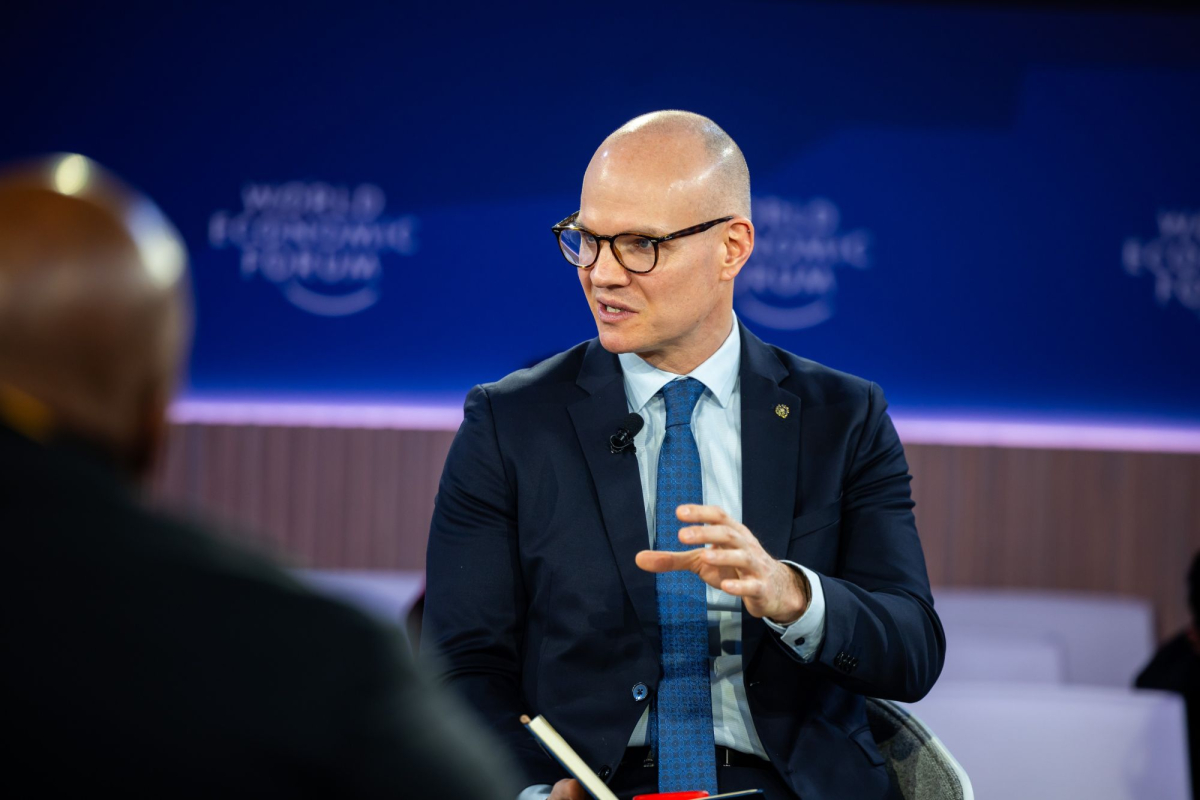
Jan Rosenow a professor of Energy and Climate Policy at Oxford University and Jackson Senior Research Fellow in Energy at Oriel College
Last year I received an invitation to participate at the World Economic Forum’s Annual Meeting in Davos. I agreed to come, being able to contribute to discussions on the future of energy at the highest level. But I did not know what to expect as I never been before.
Most people at Davos are CEOs and other senior leaders from the business world. Then there are heads of state and their entourages and the media. And every year the Forum invites a few experts including academics to attend the event. In my role as a professor of Energy and Climate Policy and a Research Fellow at Oriel College I felt this would be an opportunity not to be missed to help bridge research, industry and policy all in one place.
Davos is often portrayed as a place of noise — big names, big politics, big statements. And yes, much of that is there. For first-timers like me Davos is overwhelming. But as so often, the more interesting signals emerge not from the headlines, but from the quieter conversations and working sessions that rarely make the news. Davos is primarily about convening and allowing for conversations to happen.
Having had the opportunity to facilitate and speak in several sessions, I was struck by how consistently one topic kept resurfacing: clean energy. Not as an abstract climate ambition, and not as a fashionable add-on, but as a central question of economic strategy, competitiveness and geopolitical positioning.
This was evident across a wide range of discussions I took part in or listened to. Building on a recent WEF white paper I co-authored, ‘Industrial Electrification: Strategies and Policies for Europe,’ I had the chance to facilitate working sessions that moved beyond abstract targets.
We focused on the “spark gap” — the price ratio between electricity and gas — and the concrete policy shifts needed to make clean industry a commercial reality — from energy security and grids to industrial policy and emerging “electro-states”. The presence in these sessions was telling: senior policymakers, industry leaders and investors engaging seriously with the question of how energy systems will underpin future prosperity. Clean energy was not treated as a marginal concern, but as infrastructure in the deepest sense of the word.
What also stood out was the tone. These were not ideological debates about distant targets. Instead, there was a strong focus on implementation in the next five to ten years: what needs to be built, financed, regulated and scaled — and what happens if it is not.
In conversations with business leaders outside the formal sessions, a similar message emerged. Despite political turbulence in many countries — including increasing opposition to clean energy in parts of the United States — there remains strong confidence in the commercial opportunities of the clean energy transition. The logic is increasingly economic rather than ideological. Falling technology costs, supply chain re-shoring, energy security and industrial competitiveness are powerful drivers that do not disappear with a change of government.
This political divergence also highlights a strategic moment for Europe. In a global context where energy policy is becoming more fragmented, Europe has an opportunity to be clearer and bolder. Not necessarily louder — but more consistent. Clear direction of travel, stable policy frameworks and credible long-term signals matter enormously for investment decisions. Where those conditions exist, capital follows.