Provost to help protect Ukraine heritage amid Russia’s invasion

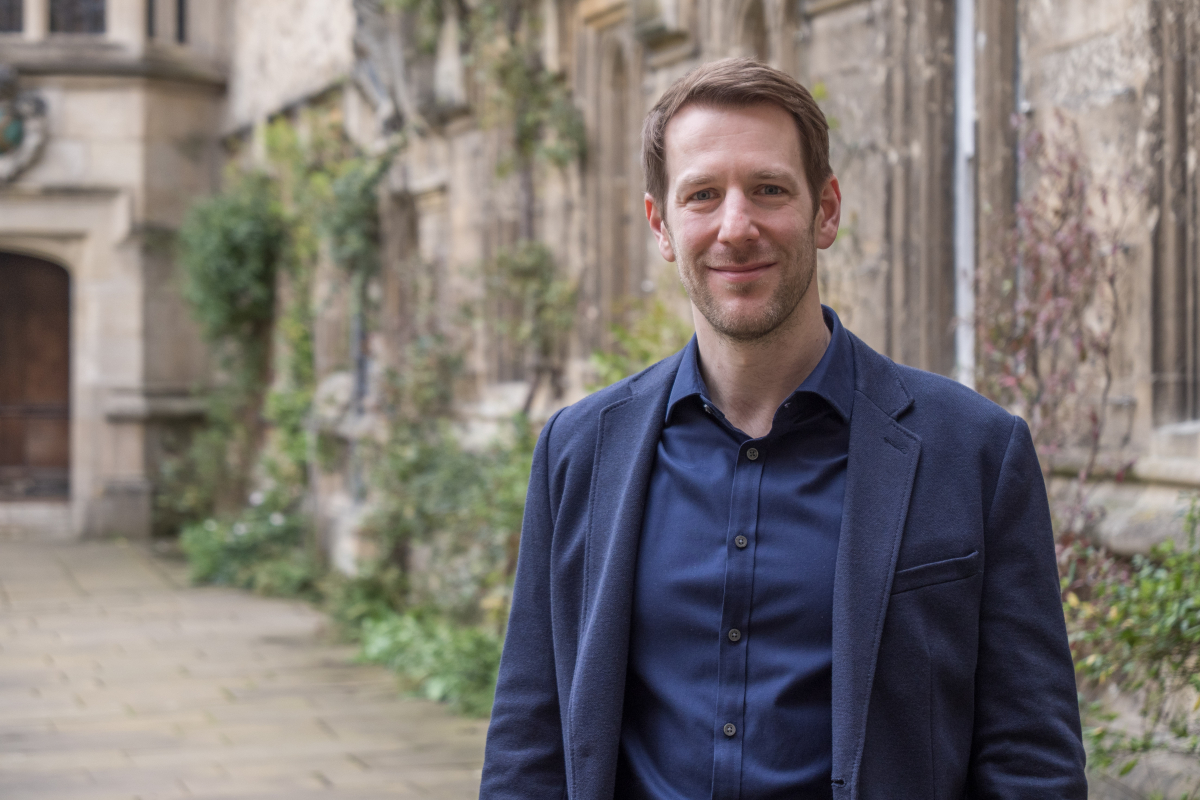
Dr Markus Brill has joined Oriel College as a Fellow and tutor in Computer Science
The first-past-the-post voting rule is used in political elections and other formal voting around the globe. But it does not always lead to the fairest decisions, says computer scientist Dr Markus Brill.
If there is an election in which fewer than half of voters choose the most popular candidate, and nearly everyone has the same second choice, a voting rule that selects the candidate with broad consensus as everyone’s second preference may be more appropriate, Brill argues.
“Once you start looking at different ways of making decisions, you start to see a whole world of different ways of doing things,” he says.
Brill joined Oriel College as a Fellow and tutor in Computer Science in January 2026. He is also an associate professor at the Oxford University’s Department of Computer Science.
As a computational social choice theorist, he applies mathematical analysis to collective decision-making and, specifically, to the rules and algorithms used to compute voting outcomes.
Where traditional social choice theory asks which voting rules satisfy desirable fairness properties, computational social choice asks how fair outcomes can be efficiently computed and how to design systems that help people easily express and communicate their preferences in the first place.
“What social choice theory does is it basically comes up with mathematically precise ways of defining properties of voting rules,” he says.
“There are certain properties, like different versions of fairness, that the voting rule ideally should satisfy.
“Rather than judging the merits of the voting rule simply by how intuitively appealing it sounds, you actually want to judge the merits of a voting rule by how many or which of those mathematically defined fairness properties it satisfies.”
It can be proven mathematically, says Brill, that there does not exist a “perfect voting rule” that satisfies every fairness property.
Because of “impossibility results”, decisions made based on votes can never fully satisfy a mathematically precise and exact notion of fairness, but only approximate it. Trade-offs always need to be made, based on which properties of fairness are most important in a given context.
Before joining Oriel, Brill was an associate professor at the University of Warwick. He completed his doctorate at TU Munich on social choice theory and has held previous positions at Duke University, Oxford and TU Berlin.
At TU Berlin he led the Emmy Noether research group on the foundations of interactive democracy.
In recent years he has researched participatory budgeting, an increasingly popular democratic practice in which citizens vote on how to spend part of a public budget across a range of proposed projects.
The practice has already been adopted in major cities such as Madrid, Paris and New York City, as well as across the Netherlands and Poland, with budgets in some places in the order of €50 to €100 million.
Cities typically invite residents to approve as many projects as they like. The task is then to decide which combination of projects to fund within a fixed budget.
Decisions that need to be made include when to fund a popular, expensive project over several less popular but cheaper proposals.
The theoretical challenge for Brill is defining what fairness means in this context, and which principles a voting rule for allocating funds ought to satisfy.
“How,” he asks, “can we in a mathematically precise way say what it means for the outcome … to satisfy proportional representation?”

Brill envisages digital technologies like artificial intelligence and the internet transforming how people vote and how democratic decisions are made.
He says that local democratic innovations such as participatory budgeting could be a “stepping stone” to larger changes to democratic processes.
“Voting, we still do it like we did it for hundreds of years,” he remarks.
According to Brill, research by social choice theorists like himself could help shape new democratic innovations, leading to more representative decisions.
It could also, he says, support new interactive voting systems that allow people to express their preferences on a more regular basis.
Brill is also applying computational social choice to artificial intelligence safety.
AI systems are increasingly expected to reflect human values, and decisions therefore need to be made about what this looks like in practice.
Brill says a key challenge is how to “elicit and aggregate the safety preferences of different stakeholders in a principled and mathematically rigorous way”.
And social choice theory, he argues, offers exactly the tools needed to meet this challenge.
As a Fellow and tutor in Computer Science at Oriel Brill succeeds Dr Mike Spivey, who retired after nearly three decades in the role.