Viewing archives for College
Bavarian State Minister for Health meets Provost and Fellows
Bavarian State Minister Judith Gerlach visited Oriel College with a delegation from Bavaria’s Health Ministry
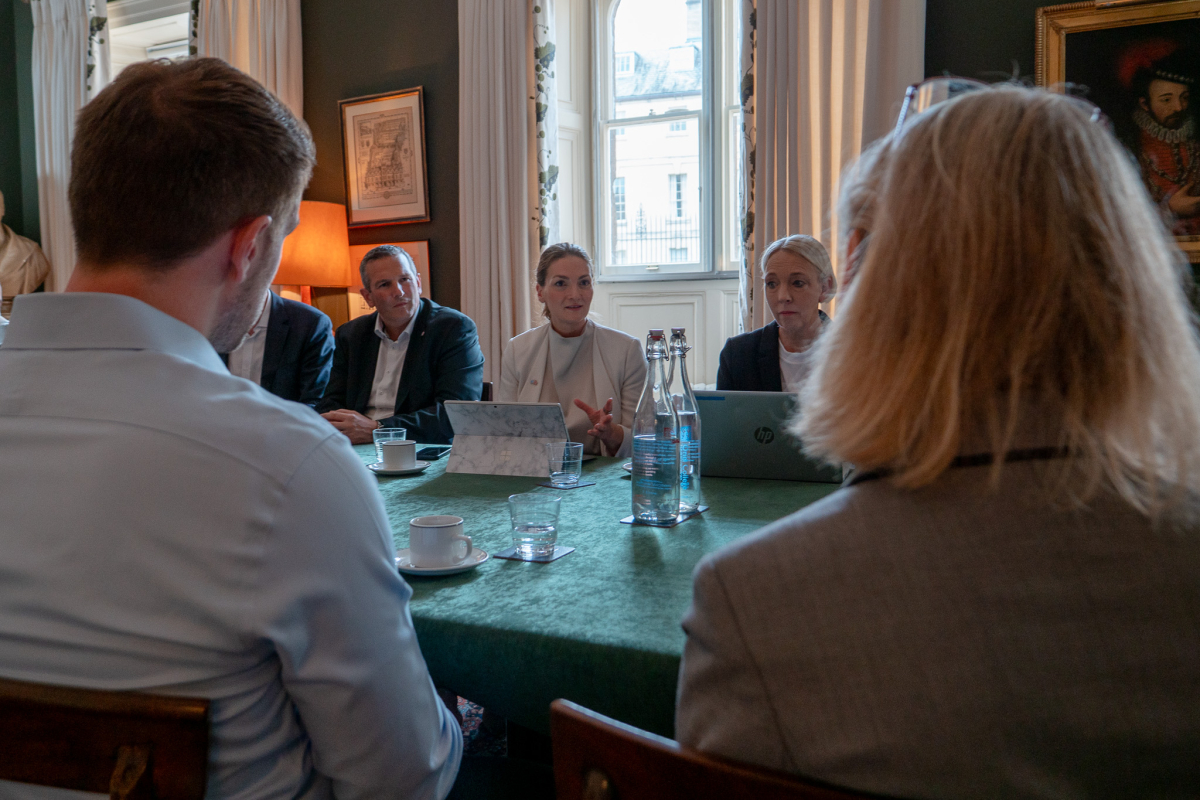
The Provost of Oriel College welcomed the Bavarian State Minister for Health Judith Gerlach and a delegation from Bavaria’s Health Ministry to Oriel College on Friday 25 September.
The Bavarian delegation also met the Provost at the German Embassy in London on Thursday 24 September.
At Oriel College, the delegation met Professor Lynne Cox, George Moody Fellow, and Dr Markus Brill, Fellow in Computer Science.
Cox, Professor of Geroscience at Oxford University, discussed healthy aging, clinical frailty and health interventions with Minister Gerlach.
Brill spoke about his research into voting systems and algorithms for collective decision-making, and the relevance of this research to AI alignment.
Oriel College’s Provost, Lord Mendoza, said:
“We were thrilled to welcome Minister Judith Gerlach and her delegation from the Bavarian Health Ministry to Oriel College.
“Our Fellows shared insights from their leading research into ageing, longevity and collective decision-making.
“We value this new relationship and look forward to seeing how it develops.”
Minister Gerlach and the Bavarian delegation also viewed Oriel’s Chapel and Hall during their visit to the College.